Unlike electric and heating bills that swing visibly with winter blizzards and summer heatwaves, water bills tend to creep upward quietly. A rate adjustment here, an extra volumetric tier fee there, and suddenly a household that paid 65 dollars monthly is facing a statement exceeding 115 dollars without any obvious change in lifestyle.
The Real Drivers of Rising Water Bills
Rising water costs stem from two distinct sources: municipal infrastructure rate increases and invisible domestic water waste. Municipalities across the country increased water and sewer utility rates between 4 percent and 9 percent recently to finance aging subterranean pipe replacements and advanced filtration systems. In 2026, average residential water bills hover near 90 dollars per month nationwide.
However, external rate increases represent only half of your bill. The remainder comes down to internal usage patterns and hidden household leaks. Toilets that seep water silently into the bowl, old showerheads pushing 2.5 gallons per minute, and uncalibrated irrigation timers can easily push a standard home into penalty pricing tiers.
Where Household Water Actually Goes
The typical American family consumes roughly 300 gallons of water daily. Indoor water usage concentrates heavily in four primary fixtures: toilets account for 24 percent, showers draw 20 percent, faucets use 19 percent, and clothes washing machines require 17 percent. Together, these four areas represent 80 percent of all indoor consumption.
Understanding Tiered Water Rate Structures
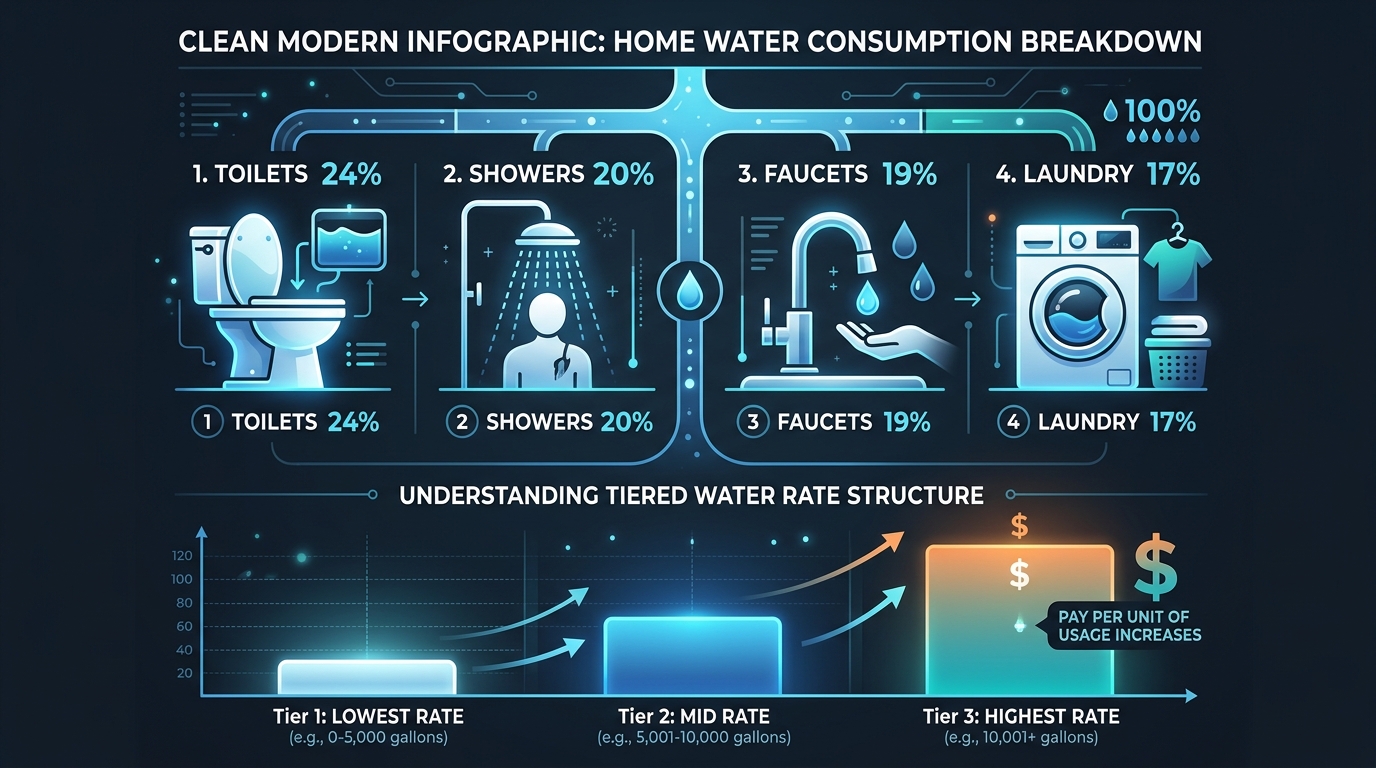
Most municipal water utilities bill residential properties using an increasing block tier pricing model. This structure charges modest base rates for essential indoor needs, but applies steep financial penalties once household consumption exceeds set thresholds.
Consider how water rate tiers typically operate in practice:
Every single gallon eliminated at the top of your consumption profile saves money at the highest marginal rate. Staying within Tier 1 and Tier 2 keeps your annual water budget strictly under control.
The Silent Toilet Leak: Performing the 5-Minute Dye Test
A leaking toilet flapper represents the single most expensive hidden water defect in residential properties. Unlike a dripping faucet, a compromised toilet valve makes no splashing sound and creates no puddles. Water runs silently from the upper tank past a degraded rubber flapper directly into the bowl and down the sewer line.
A moderately leaking flapper can waste between 200 and 4,000 gallons of clean water every single day. Because this volume is continuously billed at top tier penalty rates, an unaddressed toilet leak can add 150 to 500 dollars to a single monthly utility statement.
The 5-Minute Food Coloring Test Protocol
- Remove the ceramic lid from your toilet tank.
- Add 10 drops of standard dark food coloring (or a leak detection dye tablet) directly into the standing tank water.
- Do not flush the toilet. Wait quietly for 15 minutes.
- Inspect the toilet bowl. If any color has seeped into the clear bowl water, your rubber flapper seal is failing and leaking continuously.
A replacement rubber flapper costs under 10 dollars at any hardware store and takes less than ten minutes to install without specialty tools. Replacing a faulty flapper pays for itself within 48 hours of normal operation.
High-Efficiency Fixtures and Utility Rebates
Upgrading your primary water fixtures delivers ongoing water and energy savings month after month:
- WaterSense Low-Flow Showerheads: Standard legacy showerheads flow at 2.5 gallons per minute. Certified WaterSense fixtures flow between 1.5 and 1.75 gallons per minute while employing pressure chambers to maintain satisfying spray force. For a family of four, switching two showerheads saves approximately 28,000 gallons annually, cutting both water bills and gas or electric water heating costs by 60 to 90 dollars per year.
- Kitchen and Bathroom Aerators: Screw-in aerators mix micro-air bubbles into the water stream, reducing faucet flow by 30 percent without reducing rinse effectiveness. A pack of three aerators costs under 8 dollars.
- Modern Dual-Flush Toilets: Older toilets built before 1994 consume 3.5 to 7.0 gallons per flush. Modern high-efficiency toilets use only 1.28 gallons per flush. Replacing legacy commodes saves up to 40 dollars per person annually.
Always inspect your local water district website prior to purchasing hardware. Many municipal utilities provide direct rebates of 50 to 150 dollars for high-efficiency toilets and distribute free low-flow showerheads and aerators upon request.
Municipal Negotiations: The Hidden Leak Adjustment Protocol
Water utilities are regulated public entities. You cannot call and haggle your base volumetric rate the way you would with a private service provider. However, municipal billing departments have established formal relief protocols that many consumers never utilize.
If an underground pipe burst, irrigation crack, or running toilet caused a sudden 400 dollar bill spike, do not simply pay the penalty tier balance. Once the leak is repaired, call your utility and request a formal Leak Adjustment Claim Form. When you provide proof of repair (such as a plumber receipt or a hardware receipt for replacement parts) and demonstrate that usage has returned to baseline, most utilities will re-rate the excess volume at the lowest Tier 1 base rate, saving you hundreds of dollars in penalty fees.
Additionally, ask about Customer Assistance Programs (often called H2O Help to Others or Lifeline Rates). Many municipal water districts provide recurring monthly credits of 20 to 30 dollars for qualifying households based on local income thresholds.
The Bottom Line
A high water bill is not an unalterable fact of homeownership. It is a straightforward system governed by four key elements: fixture flow rates, daily habits, invisible leaks, and billing tier thresholds.
Conduct the food coloring test on all household toilets today, install low-flow aerators and showerheads, and keep your utility's leak adjustment policies in mind if an unexpected spike occurs. A few small adjustments will keep your home firmly in the lowest billing tiers.
Complete The Ghost Bill Series
Master the rest of your household budget with our tactical companions:
- The Ghost Bill Solution Hub: Complete irregular bill blueprint and sinking fund automation.
- Slashing Your Electric and Gas Bills in 2026: Time of use strategies, smart upgrades, and utility rate structure audits.
- The Car Insurance Negotiation Playbook: Step by step carrier re-rating and discount capture.