
Auto insurance is the recurring ghost bill that never truly disappears. Between 2020 and 2026, auto insurance premiums across the United States climbed by over 52 percent, pushing the national average annual policy above 2,100 dollars. In metropolitan and high-density states, many drivers pay between 3,000 and 5,000 dollars annually for coverage they rarely review.
The Preventable Cost of Insurance Inertia
Unlike a streaming subscription you can easily pause or a water bill reduced by fixing a flapper, insurance pricing feels fixed and opaque. The reality is quite different: the exact same driver profile with identical coverage limits can cost 1,200 dollars with one carrier and 1,900 dollars with another simply based on how proprietary risk algorithms weight individual rating factors.
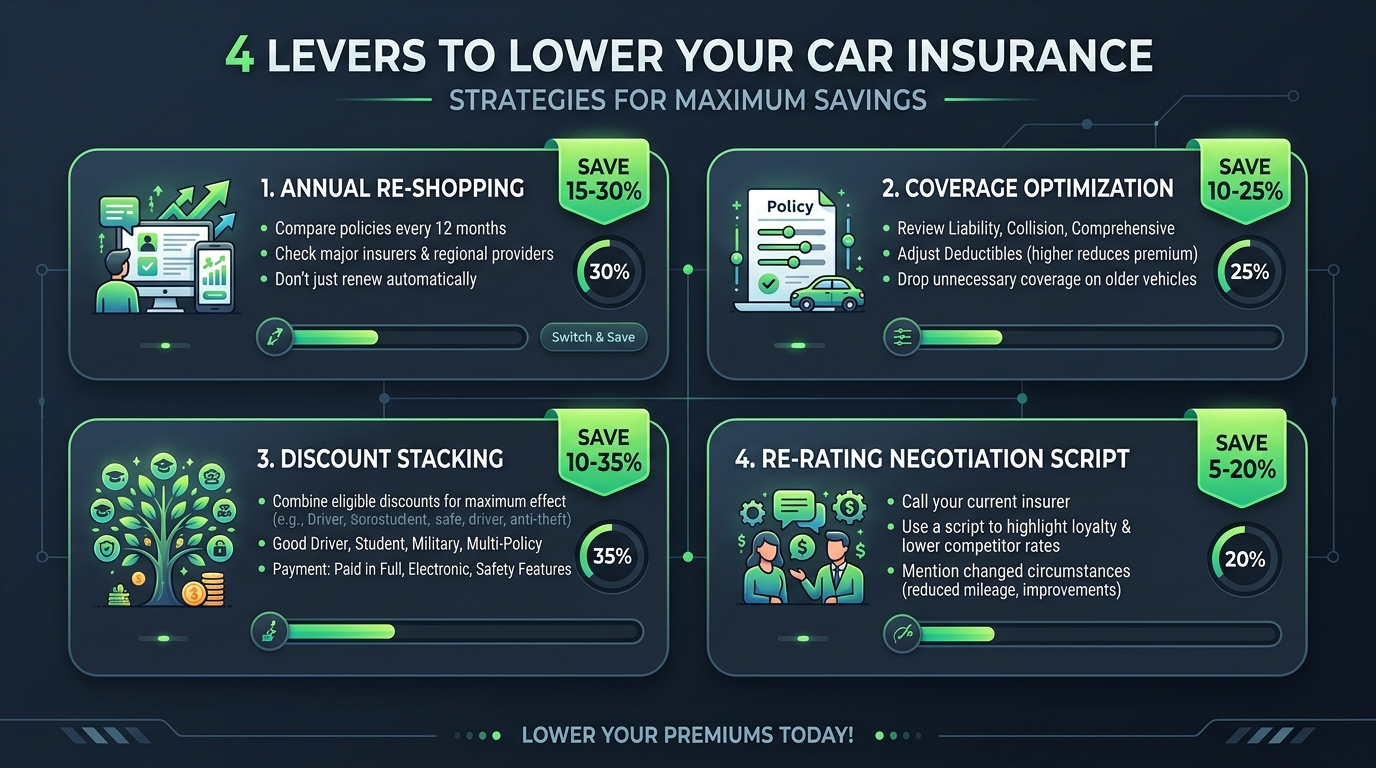
Insurers understand that the vast majority of policyholders allow policies to auto-renew every six months without comparing rates. Companies count on customer inertia. Taking control of your premium requires executing four strategic moves:
Comparing direct and independent broker quotes every 12 months to avoid the loyalty penalty.
Pruning redundant endorsements and aligning physical damage deductibles with liquid savings.
Requesting every available unapplied credit including bundling, paid-in-full, and telematics.
Conducting structured annual policy reviews with retention departments using competitor data.
Lever 1: Shop Every 12 Months Without Exception
The single highest return action in personal finance is re-shopping your auto policy on an annual cycle. The insurance industry operates on price optimization models that penalize customer tenure while offering promotional rates to attract new policyholders. New customer pricing averages 20 to 35 percent below renewal rates for equivalent coverage.
Every 12 months (or whenever your six-month renewal packet arrives), obtain fresh quotes from three to five providers. Include both major national direct carriers and an independent insurance broker who can query regional underwriters simultaneously. Across identical driver risk profiles, the spread between the lowest and highest quote averages 642 dollars annually.
Lever 2: Optimize Coverage and Deductibles
Lowering your premium does not mean gutting vital liability protection. Instead, eliminate redundant add-ons and adjust physical damage deductibles to reflect your vehicle age and liquid emergency reserves:
- Drop Collision on Older Vehicles: If your vehicle market value has fallen below 4,000 dollars, the annual cost of comprehensive and collision coverage often approaches the maximum payout you could ever receive after subtracting your deductible. A reliable guideline is to drop collision when the annual collision premium exceeds 10 percent of your car book value.
- Prune Redundant Add-Ons: Rental vehicle reimbursement costs 10 to 15 dollars per month. If your household owns a secondary vehicle or can rely on public transit or rideshare during a minor repair, remove it. Similarly, if you maintain roadside assistance through AAA or a premium credit card, cancel duplicate carrier roadside packages.
- Adjust Your Physical Damage Deductibles: Increasing your comprehensive and collision deductible from 500 dollars to 1,000 dollars typically reduces your annual premium by 15 to 25 percent. If you maintain adequate emergency funds in a high-yield account, the cumulative premium savings over two to three years easily surpass the additional out of pocket risk.
Lever 3: Stack Every Eligible Discount
Carriers offer dozens of statutory and promotional discounts, but underwriters rarely apply them automatically without policyholder requests. Review this checklist with your representative:
Lever 4: The Carrier Re-Rating Phone Script
Insurance rates are regulated by state insurance commissioners, meaning front-line agents cannot arbitrarily modify premiums on a whim. The objective of your call is to audit rating factors, correct administrative mistakes (such as incorrect annual mileage estimates or outdated commute distances), and trigger a complete policy re-rating.
Call your carrier customer service department and use this field tested conversation script:
"Hello, I am conducting an annual review of our household insurance costs and comparing renewal numbers with competing regional carriers. My renewal quote is noticeably above rates available in the current market for identical bodily injury and property damage limits. Before I switch carriers, I want to conduct a full re-rating audit of my policy. Specifically, please verify my current annual commute mileage, review our multi-policy bundling status, check for defensive driving and safety equipment discounts, and confirm whether my credit tier rating has been updated. What is the most competitive rate you can issue today?"
If the representative is unable to adjust the pricing, politely ask to be transferred to the policy retention or customer loyalty group. Retention specialists possess broader underwriting authority to apply discretionary credits.
Five Critical Insurance Gotchas to Navigate
Usage-based telematics mobile apps promise discounts of up to 30 percent for safe drivers. However, many programs actively penalize hard braking events, rapid accelerations, and late-night driving between midnight and 4 AM. In some states, poor driving telemetry can increase your renewal premium rather than discount it. Always ask your agent: 'Is this telematics program strictly discount-only, or can telemetry data raise my renewal pricing?' If it can raise your rate and you drive in heavy urban traffic, decline enrollment.
In most states, auto insurers use credit-based insurance scores as a primary risk predictor. Actuarial data shows drivers with poor credit scores pay an average of 71 percent more than drivers with excellent credit for the exact same vehicle and coverage. If your credit score has improved over the past year, re-shopping your policy immediately can unlock substantial rate reductions. Note that California, Hawaii, Massachusetts, and Michigan prohibit credit-based auto insurance scoring by state law.
Dropping down to state minimum liability limits appears tempting because it can cut premiums by over 60 percent. However, state minimums (such as 25,000 dollars for bodily injury) are dangerously outdated. If you cause a multi-vehicle accident with modern medical costs, damages will quickly exceed minimum limits, leaving your personal home equity, bank savings, and future wages exposed to civil judgments. Optimize collision deductibles instead of stripping essential liability coverage.
Insurers frequently highlight a 50 dollar loyalty discount on renewal notices. In reality, that modest credit masks an underlying 200 dollar baseline rate creep. Never assume that tenure protects you from overpaying. Always run fresh comparison quotes against competitors as if you were a first-time applicant.
You are legally entitled to cancel an auto insurance policy at any time, even mid-term. Most insurers will refund unused prepaid premiums on a pro-rata basis. However, certain discount carriers assess a short-rate fee (often 10 percent of the unearned balance or a flat 50 dollar charge). Factor any cancellation fees into your transition timeline to ensure immediate net savings.
The Bottom Line
Auto insurance is not an uncontrollable tax on car ownership. It is an actively manageable financial product. Re-shop your policy every 12 months, eliminate redundant endorsements on aging vehicles, stack every discount you qualify for, and request policy re-rating using concrete market quotes.
Devoting thirty minutes once a year to policy comparison can easily recover 400 to 800 dollars annually for your household budget.
Explore The Ghost Bill Series
Master all your irregular and monthly expenses with our complete guides:
- The Ghost Bill Solution Hub: Complete irregular bill blueprint and sinking fund automation.
- Slashing Your Electric and Gas Bills in 2026: Time of use strategies, smart upgrades, and utility rate structure audits.
- The Water Bill Survival Guide: Stop silent leaks and navigate municipal usage tiers.