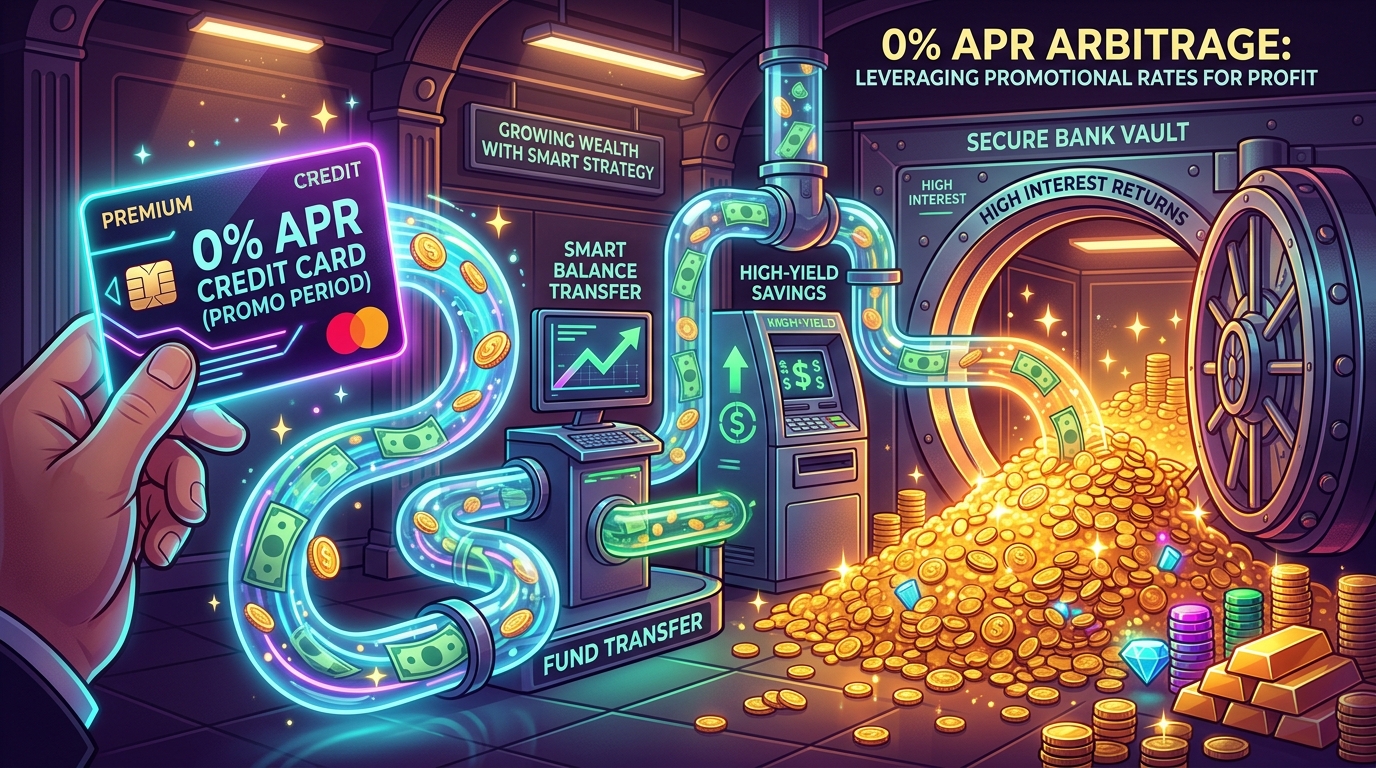
The Federal Reserve's rate hikes have pushed savings yields to around 4.50%, yet credit card issuers continue to offer introductory 0% APR periods for up to 21 months. By borrowing at 0% and placing that cash into a secure, FDIC-insured account, you can capture the profit spread. This is essentially a retail carry trade.
TL;DR Summary
- Savings yields are near 4.50%, while credit card issuers offer 0% APR for up to 21 months.
- Borrowing at 0% and investing in safe assets captures the spread, generating pure profit.
- For example, $10,000 at 4.50% APY earns about $787 over 21 months. After a standard 3% balance transfer fee, you net roughly $487.
- The strategy requires precision. A single missed payment can ruin the entire plan.
- Your state income tax rate should dictate whether you use a High-Yield Savings Account or Treasury Bills.
- Never invest borrowed capital in volatile assets like stocks or crypto.
Who This Strategy Is For
Before we dive into the math, let us establish a filter. This strategy only works if you can check every single box:
Required to qualify for the longest 0% offers.
A documented habit of paying every bill on time.
You must not have any existing credit card debt.
A separate emergency fund is mandatory.
You can leave borrowed money untouched for 21 months.
If any box is unchecked, skip to the Decision Matrix at the end — there is likely a better first move for you.
Why This Opportunity Exists
When you trace the business model of credit card issuers, the 0% offer stops looking like free money and starts looking like a calculated trap for the unprepared.
- Customer Acquisition: Retaining a cardholder costs far less than acquiring a new one. A 21-month 0% window is the most lucrative bait in retail finance.
- Expected Breakage: Issuers model that a significant portion of promotional users will miss a payment, carry a balance past the promotional period, or default entirely. When this happens, the balance converts to 17% to 28% APR, plus penalty fees.
- Interchange Revenue: Every swipe during the promotional period earns the issuer merchant fees, regardless of the APR.
The arbitrageur is simply a rounding error. The issuer's economics assume most people will not systematically exploit the offer. Being the exception is the entire goal of this strategy.
The Math: $10,000 at 0% for 21 Months
Step 1: Secure the Capital. Open a card offering 0% introductory APR for 21 months on purchases or balance transfers.
Step 2: Deploy the Capital. Move $10,000 into a high-yield savings account or a Treasury Bill ladder.
Step 3: Calculate the Gross Return.
| Variable | Value |
|---|---|
| Capital deployed | $10,000 |
| HYSA APY | 4.50% |
| Annual interest earned | $450 |
| Total over 21 months (gross) | $787.50 |
Step 4: Account for Fees. Issuers typically charge a 3% to 5% balance transfer fee. On $10,000, that is $300 to $500.
Step 5: Calculate Net Profit.
| Scenario | Gross Earned | Fee | Net Profit |
|---|---|---|---|
| 3% fee + 4.50% APY | $787.50 | $300 | $487.50 |
| 5% fee + 4.50% APY | $787.50 | $500 | $287.50 |
Even the worst-case fee scenario nets $287.50 on capital you didn't have 21 months ago. If you use a purchase-based 0% card by charging necessary expenses and saving your cash, there is no transfer fee, meaning the full $787 is yours.
The Barbell Architecture: Where to Park the Capital
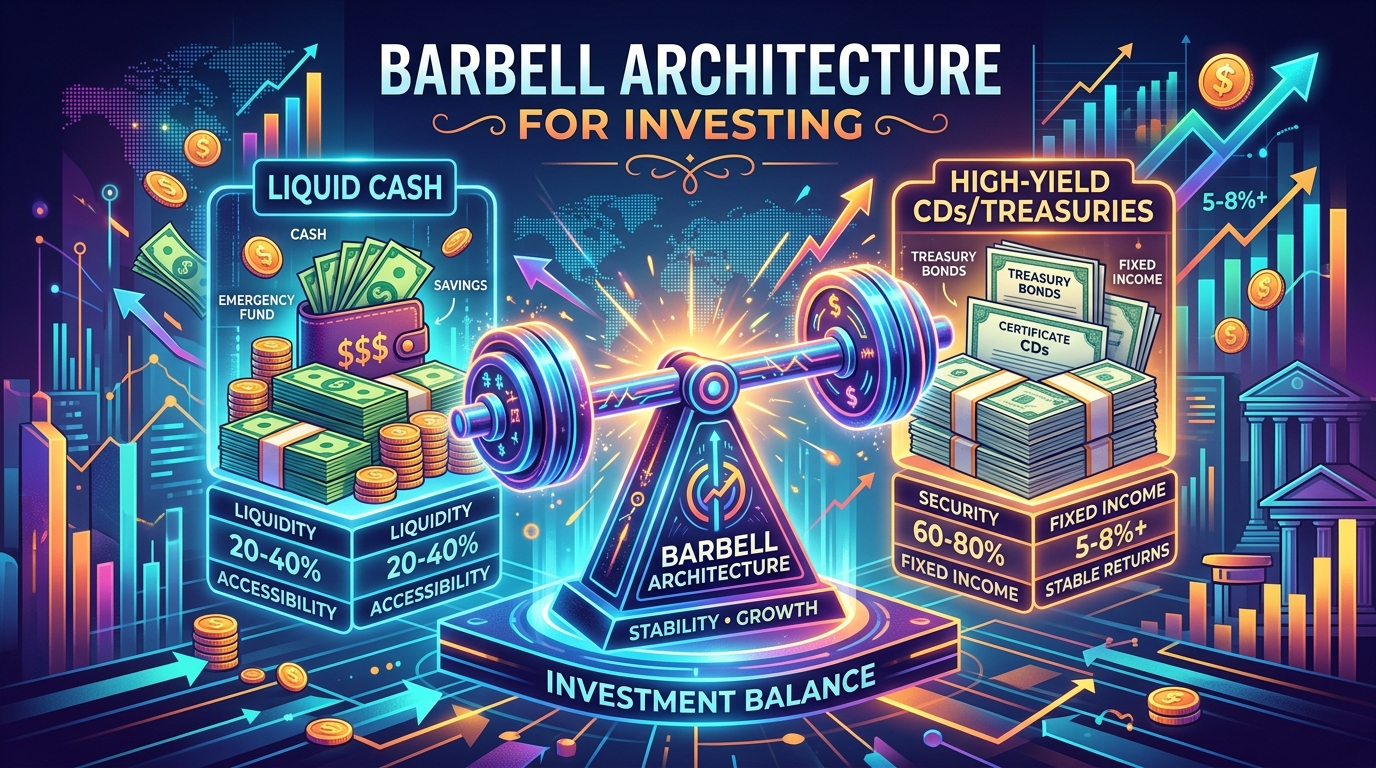
We recommend a barbell approach to deploying the borrowed capital. This balances liquidity with locked-in high yields.
Liquidity Layer (30% to 40%)
Use a High-Yield Savings Account or Money Market Fund offering 4.00% to 4.50% APY. This provides instant access to cash while yields track the federal funds rate.
Ladder Layer (40% to 50%)
Invest in Certificates of Deposit staggered at 6, 12, and 18 months, yielding 4.20% to 5.00% APY. This locks in elevated yields. Crucially, ensure maturities align with your payoff timeline.
Opportunistic Layer (10% to 20%)
Use short-term Treasury Bills or no-penalty CDs yielding around 4.90%. This provides rate exposure without a bank middleman.
The Calendar Alert Framework: Flawless Execution
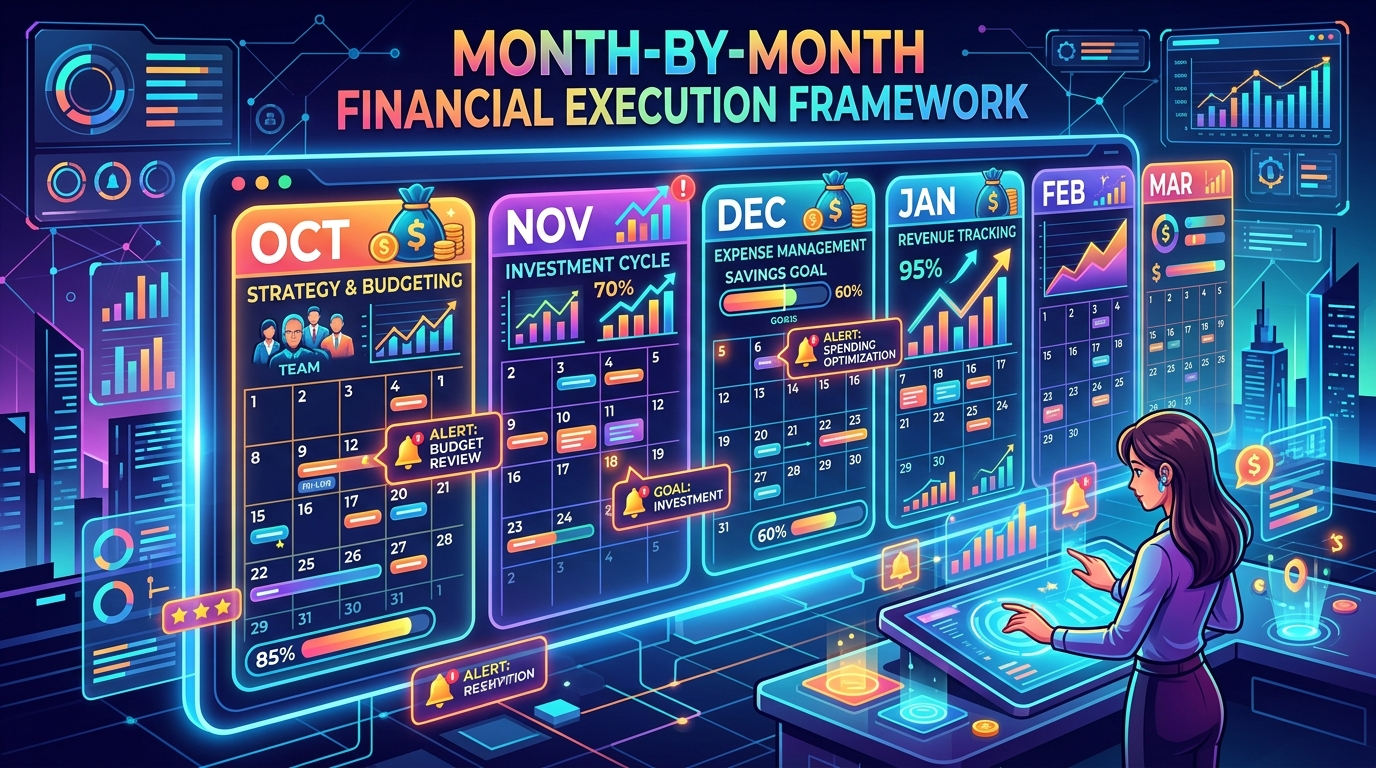
This is the most critical operational section. Missing a deadline is the one mistake that wipes out the strategy. The average APR on interest-bearing accounts is over 22%. On a $10,000 balance, that is roughly $184 per month in interest you were not paying the day before.
Concrete example: card opened January 1
| Month | Action | Alerts |
|---|---|---|
| Jan 1 (Mo 0) | Card opened; 21-month 0% APR begins | Autopay minimum; first monthly review |
| Feb 1 (Mo 1) | Deploy $10,000: $3,500 HYSA, $4,500 CD ladder, $2,000 T-bills | CD maturity alerts (Mo 7, 13, 19) |
| Jul 1 (Mo 6) | First CD rung matures ($1,500). Move to HYSA | 6-month check-in |
| Jan 1 (Mo 12) | Second rung matures. Reassess rates | 12-month wind-down milestone |
| Jul 1 (Mo 18) | Third rung matures. Everything liquid | 90-day countdown |
| Sep 1 (Mo 20) | Pay card in full from payoff fund | Final payoff alert |
| Oct 1 (Mo 21) | Promo expires. Balance: $0 | Verify $0 posted |
The State Tax Twist
This is the section most arbitrage guides miss entirely.
Interest on US Treasury securities is exempt from state and local income tax. However, interest on a HYSA or CD is fully taxable at every level. A lower-yielding T-bill can beat a higher-yielding HYSA after tax, depending entirely on your state.
Taxable-Equivalent Yield = T-bill Yield / (1 - Your State Marginal Tax Rate)
Using a 3.82% T-bill yield vs. a 4.20% HYSA APY over 21 months on $10,000:
| Your State Marginal Rate | Example | T-Bill Equivalent Yield | Winner |
|---|---|---|---|
| 0% | TX, FL, WA, NV, TN | 3.82% | HYSA (+$66) |
| 5.0% | Mid-bracket states | 4.02% | HYSA, narrowly |
| 9.3% | Upper-middle CA | 4.21% | Effectively a tie |
| 13.3% | Top CA bracket | 4.41% | T-Bill (+$37) |
Break-even: ~4.1% state tax. Above that rate, T-bills win after tax; below it, the HYSA's higher headline yield wins.
Behavioral Failure Modes
The math has never killed this trade. Human behavior has. Here are the classic ways to fail:
- Spending the borrowed capital. The money feels like found cash. Always keep the funds in a separate institution.
- Missing a minimum payment. Set up autopay on day one. This is non-negotiable.
- Forgetting a CD maturity. If your money is locked up past the promotional deadline, you will pay hefty penalty fees to withdraw it.
- New purchases on the 0% card. This quietly turns a liability-management plan into genuine consumer debt.
- Using the funds as income. The payoff fund is a liability reserve, not a bonus check.
Critical Warnings
Do Not Ignore These Rules
- Never miss a minimum payment. A single missed payment can revoke the 0% APR and trigger 17% to 28% rates on the entire balance.
- Never carry a balance past the intro period. One billing cycle of interest erases months of careful spread capture.
- No volatile assets. FDIC-insured deposits and Treasuries only. Investing borrowed money in stocks is leveraged speculation, not arbitrage.
- Maintain the payoff fund at all times. The accumulated savings must always cover the card balance in full.
Decision Matrix
| Your Profile | Recommendation |
|---|---|
| Score 700+, disciplined, separate savings | ✅ Proceed. The math is on your side. |
| Score 670–699, some impulse risk | ⚠️ Purchase-based 0% only; no balance transfers. |
| Score below 670 | ❌ Won't qualify for the best offers; build score first. |
| Carrying existing high-interest debt | ⚠️ Use 0% to kill that debt instead — a balance transfer for payoff is strictly better math. |
| No emergency fund | ❌ Build 3–6 months of expenses first. |
The Bottom Line
The Federal Reserve's rate path creates the spread. Your discipline determines whether you capture it. The calendar framework guarantees you never miss a deadline. The barbell strategy keeps you positioned for both rising and falling rates. And state tax optimization keeps more of the profit in your pocket.
This is not a get-rich-quick scheme. It is a systematic, tax-aware, risk-managed strategy that converts monetary policy into personal profit for the small fraction of people willing to execute with precision. The banks have priced in the assumption that you will fail.
Prove them wrong.
Sources
- Federal Reserve, G.19 Consumer Credit Report (average APR on interest-bearing accounts: over 22%)
- Federal Reserve FOMC statement, September 16, 2026 (funds rate target 3.75%–4.00%)
- 31 U.S.C. § 3124(1) (state/local tax exemption for direct federal obligations)
- IRS Publication 550 (investment income and expenses)
- TreasuryDirect (current bill yields)